



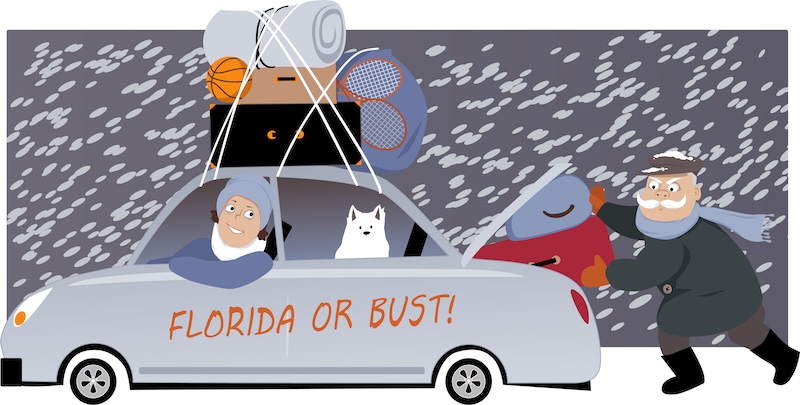
Heading south for the winter can mean months of sunshine, warmer temperatures, and a welcome change of scenery. However, splitting your year between two states can also create legal and estate planning questions. Don’t overlook while packing suitcases and making travel arrangements.
Living for a significant amount of time in another state or own property may affect more than your mailing address. Before leaving California for the winter, examine your residency, estate planning documents, property ownership, and authorized agents.
Estate Planning for Snowbirds: Where Is Your Legal Home?

People describe those who divide their time between two states often as operating their “residency” or“domicile.” Although people use the terms interchangeably, they do not share the same meaning.
You may qualify as a resident of more than one state because individual states establish their own residency rules. Generally, however, you have only one domicile. The state you consider your permanent or indefinite home, aka your domicile, functions as the place you intend to return to when you are away.
That distinction can matter because domicile and residency may affect state income taxes, estate or inheritance taxes, property rights, certain exemptions and benefits, and aspects of your estate plan. Determining domicile also involves more than simply saying which state you consider home. Your actions and connections to each state may play a role.
Because tax laws vary significantly from one state to another, talk with your tax advisor about your individual circumstances and whether you are filing appropriate returns in each state.
Owning Property in Two States Can Complicate Your Estate Planning for Snowbirds

Snowbirds who own homes in more than one state should also understand that property laws differ.
California follows community property rules, while many other states use common law property systems. These differences can affect how property acquired during marriage is characterized and what rights each spouse may have.
Real estate in another state can also complicate estate administration after death. If your estate plan relies only on a will, your loved ones may need to go through probate in each state where you own property.
A properly structured revocable living trust may help avoid multiple probate proceedings by allowing qualifying property in different states to be held in the trust. This can potentially save your family considerable time, expense, and stress when settling your affairs.

While Estate Planning for Snowbirds, Give Your Estate Plan a Pre-Travel Checkup

Even if your estate plan worked perfectly when you created it, circumstances change. Before spending several months away from home, pull out your documents and make sure they still reflect your current wishes.
Ask yourself:
- Are your trustee, executor or personal representative, and financial and healthcare agents still the right people?
- Are those individuals still willing and able to serve?
- Are your beneficiaries current?
- Do beneficiary designations on retirement accounts and life insurance policies coordinate with your overall plan?
- If necessary, can your healthcare agent arrange for you to move to another state to be closer to family?
- Does your estate plan properly address property you own outside California?
Beneficiary designations deserve particular attention because assets such as retirement accounts and life insurance generally pass to the person named on the account, regardless of what your will or trust says. An outdated designation can therefore conflict with the rest of your estate plan.
Know When Your Power of Attorney Takes Effect

A financial power of attorney can become especially important when you travel or spend extended periods away from your primary residence.
Depending on your document and applicable state law, your power of attorney may become effective immediately or only after a specified event. An immediate power of attorney generally allows your chosen agent to act once the document has been properly executed. You do not surrender your own authority; rather, your agent also has authority to handle permitted matters on your behalf.
A springing power of attorney, where permitted, generally takes effect only after a particular triggering event, commonly a determination that you can no longer manage your financial affairs. The document and applicable state law determine how that incapacity must be established.
Neither approach is automatically right for everyone. What matters is knowing what your document says, whether your power of attorney remains effective if you become incapacitated, and how easily your agent could step in if you needed assistance.
Will Your Documents Work While You Are Away?

Estate planning laws and commonly used forms vary among states, particularly for financial powers of attorney and healthcare directives.
A document that is valid in one state will generally be honored in another. In practice, however, an unfamiliar out-of-state form can sometimes create questions or delays. That becomes particularly important during a medical emergency, when healthcare providers may need to review unfamiliar documents before acting on them.
If you routinely spend several months each year in another state, consider asking an attorney licensed there to review your existing documents. If appropriate, that attorney may recommend a second financial power of attorney or healthcare directive designed for that state’s requirements and familiar to its institutions and medical providers.
Put Estate Planning on Your Snowbird Checklist

Before heading south, you probably already have a checklist: arrange for the mail, prepare the house, fill prescriptions, confirm travel plans, and make sure someone can reach you in an emergency. Your estate plan deserves a place on that list.
A review does not necessarily mean rewriting everything. Sometimes the most important step is confirming that your documents still reflect your wishes, the right people have authority to help you, your beneficiary designations coordinate with the rest of your plan, and your documents can serve you effectively while you are away.
If you split your time between California and another state, we can review your California estate plan and help identify issues you may want to address before you leave. Taking care of these details before your trip can help ensure your plan continues working as intended wherever you spend the winter.
About Skvarna Law Firm in Glendora and Upland, California
Skvarna Law Firm operates offices in Glendora and Upland, California. We provide legal services. We cover San Bernardino, Los Angeles, Orange, and Riverside Counties. This includes several cities. Upland, Ontario, Rancho Cucamonga, Fontana, Colton, Rialto, Chino, Chino Hills, Glendora, Claremont, Pomona, La Verne, Montclair, San Dimas, Azusa, Covina, West Covina, Diamond Bar, Walnut, La Puente, Corona, Norco & Mira Loma. Visit SkvarnaLaw.com to learn more.
